Showing posts with label Turtles. Show all posts
Sunday, 8 July 2012
Thursday, 5 July 2012
Monday, 17 October 2011
Hawksbill sea turtle
The hawksbill sea turtle is a critically endangered sea turtle. It is the only extant species in its genus. The species has a worldwide distribution, with Atlantic and Pacific region.The hawksbill's appearance is similar to that of other marine turtles. It has a generally flattened body shape, a protective carapace, and flipper-like arms, adapted for swimming in the open ocean. It is easily distinguished from other sea turtles by its sharp, curving beak with prominent tomium, and the saw-like appearance of its shell margins. Hawksbill shells slightly change colors, depending on water temperature. While this turtle lives part of its life in the open ocean, it spends more time in shallow lagoons and coral reefs.
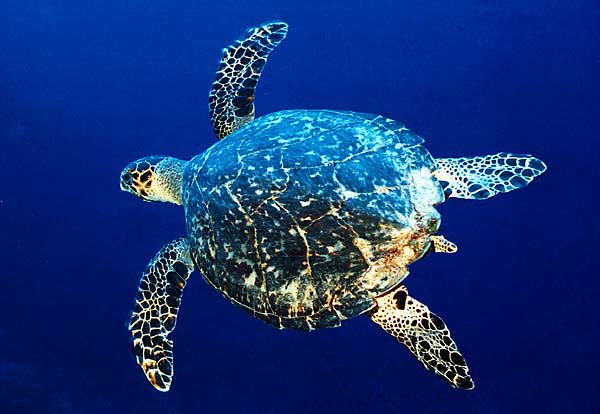
Image of Hawksbill turtle
Sunday, 16 October 2011
Loggerhead Sea Turtle
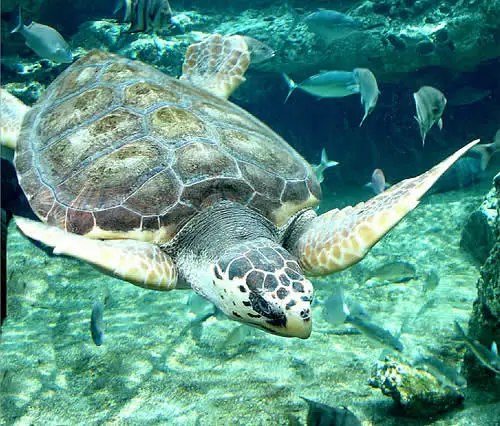
The loggerhead sea turtle is an oceanic turtle distributed throughout the world. It is a marine reptile, belonging to the family Cheloniidae. The average length of loggerhead turtle is around 90 centimetres when fully grown, although larger specimens of up to 270 centimetres have also been discovered. The adult loggerhead sea turtle weighs approximately 135 kilograms with the largest specimens weighing in at more than 454 kilograms. The skin ranges from yellow to brown in color, and the shell is typically reddish-brown. The most obvious difference being that adult males have thicker tails and shorter plastrons than the females. The loggerhead sea turtle is found in the Atlantic, Pacific, and Indian oceans as well as the Mediterranean Sea. It spends most of its life in saltwater, with females briefly coming ashore to lay eggs. The loggerhead sea turtle has a low reproductive rate; females lay an average of four egg clutches and then become quiescent, producing no eggs for two to three years. The loggerhead reaches sexual maturity within 17–33 years and has a lifespan of 47–67 years. The loggerhead sea turtle is omnivorous, feeding mainly on bottom dwelling invertebrates. It has large and powerful jaws. Loggerheads are considered an endangered species and are protected by the International Union for the Conservation of Nature.
Image of loggerhead sea turtle
Green Sea Turtle
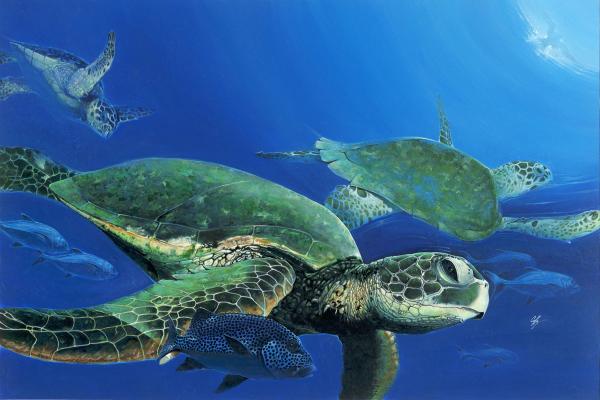
The Green sea turtle or green turtle is a large sea turtle. It is the only species in the genus Chelonia. Its range extends throughout tropical and subtropical seas around the world, with two distinct populations in the Atlantic and Pacific Oceans. The green sea turtle is a sea turtle, possessing a dorsoventrally flattened body covered by a large, teardrop-shaped carapace and a pair of large, paddle-like flippers. It is usually lightly colored, although parts of the carapace can be almost black in the eastern Pacific. It is mostly herbivorous. The adults commonly inhabit shallow lagoons, feeding mostly on various species of seagrasses. Like other sea turtles, they migrate long distances between feeding grounds and hatching beaches. Many islands worldwide are known as Turtle Island due to green sea turtles nesting on their beaches. Females crawl out on beaches, dig nests and lay eggs during the night. Later, hatchlings emerge and walk into the water. Those that reach maturity may live to age 80 in the wild. It is illegal to collect, harm or kill them. In addition, many countries have laws and ordinances to protect nesting areas. However, turtles are still in danger because of several human practices. In some countries, turtles and their eggs are hunted for food. Pollution indirectly harms turtles at both population and individual scales. Many turtles die caught in fishing nets.
Image of green sea turtle with colorful fish
Subscribe to:
Posts (Atom)